 |
| Three classic versions of The Empress tarot card, the third trump of the Major Arcana. From left to right: 1. The Empress from the Visconti Bergamo deck, 1452. 2. L'impératrice from the Tarot de Marseilles, 1890 reproduction of Arnoult's 1748 edition. 3. The Empress from the Rider-Waite deck, 1910. |
 "Then again, via the Wiki entry for salamander folklore we learn that the Bretons of France so feared the salamander that to even utter the amphibian's name aloud was potentially lethal; especially if a local salamander was in ear-shot! Oddly enough, however, the French King, Francis I (1494-1547), had as his symbol the salamander, and emblems carved with salamanders (inset, right) can be found in a number of places in his chateau at Fontainbleu... That a king might choose a salamander for an emblem is a curious thing, especially when his countrymen so loathed the creatures. Well, that is, unless King Francis had some knowledge of alchemy. For, it was around the time of Francis's reign that a Swiss-German alchemist by the name of Paracelsus ordained the salamander as the honorary elemental of fire, although it wouldn't be till the next century that Michael Maier regarded it as the metaphorical embodiment of the Philosopher's Stone."
- Quoting myself from the Trans-D Digital Art post, Eye of Newt.
 "This is a zodiac illustration from a medical almanac, 1486. Ideas of astrology in medieval Europe were a long way from today's star sign horoscopes. Although some medieval astrologers were thought to be magicians, many were highly respected scholars. Astrologers believed that the movements of the stars influenced numerous things on Earth, from the weather and the growth of crops to the personalities of new born babies and the inner workings of the human body. Ancient studies of astrology were translated from Arabic to Latin in the 12th and 13th centuries and soon became a part of everyday medical practice in Europe. Doctors combined Galenic medicine (inherited from the Greek physiologist Galen - AD 129-216) with careful studies of the stars. By the end of the 1500s, physicians across Europe were required by law to calculate the position of the moon before carrying out complicated medical procedures, such as surgery or bleeding."
- Text and illumination (inset right) from this British Library page. The illumination is an example of the "zodiac man," illustrating the body parts the various zodiac signs ruled. Note the eight-legged, amphibious-looking Scorpion near the genital area.
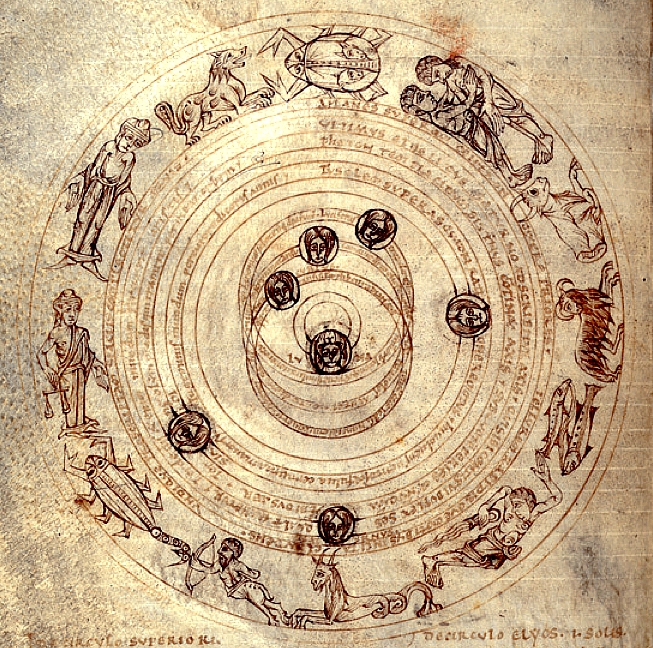 "The first horoscopes written for Jadwiga's and Jogaila's child predicted a son in mid-September 1398. However, a girl was delivered on 22 June 1399 at Wawel Castle. Reports of the time stated that the child was born prematurely. According to the horoscope, however, she was actually born a bit late. More than a bit surely - a due date of 18 June would rule out the suspicion of pregnancy as early as mid-September."
- From the Wiki entry for Queen Jadwiga of Poland. I've used this quote to demonstrate how seriously astrology was considered throughout Europe at the time... especially for the royal houses who could well afford to keep court astrologers. Inset left is an example of medieval astrological chart.
***
 Seriously, cats and kitties, when I first began this investigation, I neither intended to - nor expected to - come to any major conclusions regarding the mysterious maker(s) of the Voynich MS. Which is not to say that I've actually solved anything in the interim, but, as it turns out, I did ferret out another enigmatic personality to add to the Voynich mix... which will (no doubt) go against the grain of previous speculations, but, well, maybe it's time to shake up things a bit.
Now, obviously I'm not an expert in the medieval manuscript field, and virtually a neophyte when it comes to the Voynich MS, but, I love discovering new possibilities, and, when I do, well, in the spirit of Mac Tonnies, my impulse is to just throw the idea "out there." So, allow me to present (yet) another Voynich proposition to play around with... and you can blame it on the salamander.
 As it happened (and as I mentioned in my last Voynich post), I had cause to research salamanders in 2016, at which time I discovered that, not only was the salamander an alchemical symbol, it was also the symbol of a certain French king: Francis I (12 September 1494 - 31 March 1547). Above inset right is one of Francis's wooden emblems of a salamander emerging from flames. Inset left is Francis I (as St. John the Baptist) from a painting by Jean Clouet). (Also, see: Francis the Salamander KIng.)
Anyway, for one crazy minute I wondered if the Voynich salamander was a reference to Francis I, but, as one can see by his birthdate, apart from the fact that he wasn't born with his sun in Scorpio (he was a Libra, as was his wife Claude), he was also born too late in the century to fit our time frame. So, that was one idea that wouldn't fly.*

 Yet, In the end, I still had the feeling that some (if not all) of the figures wandering around on the zodiac pages represented actual people contemporary with the time and, possibly, born under the zodiac sign in which their caricatures are found. While this interpretation isn't without its flaws, there's seemingly no other recognizable purpose for the pages... nothing remotely "medical" nor particularly astrological beyond the central zodiac symbol. Moreover, a few of the zodiac pages (above: a page for Aries) seem to depict members of nobility - or even a royal house - in lieu of the marching nymphs.
Inset left is an another (actual) medieval astrological chart found here. Below is another 15th century "zodiac man."

In any case, if the drawings are caricatures of actual personalities and the (estimated) early 15th century time-frame is correct, identifying them - although seemingly an impossible task - might reveal (at the very least) the country of the manuscript's origin... and offer some clues regarding the author's true identity.
Ultimately (and essentially), it might only be necessary to identify a single one of them. My choice? The little Empress figure in the zodiac "chart" for Libra...


