Wednesday, February 13, 2019

RIP Opportunity Rover

Photo of the Mars Opportunity rover, found on the
Opportunity/Spirit Rover's Twitter page.

Credit for photos in this post:  NASA/JPL-Caltech/Cornell University.

Mars Rover Opportunity Is Dead After Record-Breaking 15 Years on Red Planet

"Opportunity roamed the Martian surface for nearly a decade and a half, covering more than a marathon's worth of ground and finding conclusive evidence that the Red Planet hosted large bodies of liquid water in the ancient past. The golf-cart-size rover and its twin, Spirit, also helped bring Mars down to Earth, in the minds of scientists and laypeople alike.

Spirit and Opportunity 'have made Mars a familiar place,' Opportunity project manager John Callas, of JPL, told Space.com last year, a few months after the dust storm flared up. 'When we say, 'our world,' we're no longer just talking about the Earth. We have to include parts of Mars as well.'"

- Excerpt from Space.com's obituary for NASA's Opportunity Rover (linked-to above) which fell silent in June of last year and, alas, never recovered. Here's NASA's announcement.

An early Opportunity Pan-cam shot of Meridiani Planum.
(Click-on images to enlarge.)

"The NASA Rover science team mission was to find evidence of water on Mars. They found it and their proofs, images and scientific analysis were superb and they seemed to have nailed it at 100%.Their mission was not to say, 'Oh, this sort of looks like a fossil, whadidja think?' That's what I am saying here. They can't say that. I notice now that they have found water, their senior scientists are relaxinga bit and will say 'Wouldn't this be a good place to look for fossils? Look how well everything is preserved.'To make a scientifically valuable decision about life on Mars you would have to go there with a gas analysis spectrometer and do counts and ratios for isotope carbon-12 and 13 and look for amino acids and other distinctive biological signatures. Maybe they are waiting for a mission with that kind of equipment or a mission that will return some sample soil and rocks. In any case I congratulate NASA MER team and the American people on their great contribution to planetary science."

- Canadian, Michael Davidson, from his 2004 article: Mars Fossils, Pseudofossils or Problematica? (via Posthuman Blues).

 "I previously wrote that JPL was developing an anything-but-scientific immunity to the unexpected. Apparently rocks are fair game -- but only if they resemble terrestrial rocks. Rocks with "varnished" surfaces or geometric cavities must be avoided -- perhaps because they look just a bit too organic, like chunks of bone or petrified wood where such things have no business being. Oddly colored snail-shapes are studiously avoided because, in the words of one JPL scientist, taking a close look would "waste precious machine time." He failed to note that the anomaly in question was directly in front of the Opportunity rover, starkly unavoidable. In the scheme of the rover's mission, taking a closer look would have been virtually effortless. Instead, Opportunity was (presumably) steered directly over the strange formation; JPL has taken to literally running over what it can't explain, like a monster truck imperviously crushing a line-up of decrepit cars.

- Mac Tonnies from a February 7, 2004 Posthuman Blues post. Inset right is an Opportunity shot of Erebus Crater found here. Other Posthuman Blues posts regarding Opportunity can be found here, and here.

***

Time was when any new data from Mars spawned a whole lot of controversy, and Mac was generally on-board with that. Nothing fell under his radar, so to speak, and, well, we all had a lot of fun hypothesizing about the latest Martian "find." But, those were the good old days. Nowadays, I'm not sure if anybody cares... although I noted there were plenty of nostalgic articles popping up yesterday regarding the passing of the Opportunity rover. Here's a video (via the Washington Post).

Remember Opportunity's great discovery: the Martian "Blueberries"? Well, they weren't blue, actually... it was just NASA's use of false coloration. As for the name, well it was an effective way of both popularizing them and trivializing them. There were those, however, who thought the odd spherules (inset right) were a sign of water and even life. As it happens, similar small, round concretions exist on earth, too. See this 2018 article.

Anyway, Mac wasn't altogether jaded and truculent when it came to NASA/JPL's press releases. Posted on Posthuman Blues a few days earlier in February of 2004 (re: his previous quote) was this:

"This panorama just might qualify as my favorite image ever returned from the surface of Mars. At 9 MB, it's big, with an epic quality that's hard to put into words. In the foreground you can see several "crop circles" where the lander's airbags disturbed the surface as it rolled down the incline; it's amusing to think that we're the aliens here, modifying the landscape in ways that would mystify any native onlookers. The protruding bedrock looks suggestively like the ruined vertebrae of some impossible creature, compacted and exhumed by wind. If you look at this image long enough -- and there's plenty to see and contemplate -- you get a vertiginous sense of actually being there that surpasses any virtual reality interface I have yet to sample. This small slice of Mars is redolent with history, infused with a timelessness and mystery that even Earth's natural wonders fail to evoke. In a word: Wow."


Thursday, January 31, 2019

Welcome to the ABYSS - (May 26, 2019 Update)


A tiny region of space in the Fornax constellation
via an imaging technique known as ABYSS.
(Click to  enlarge.)

"A few years ago, the Hubble Space Telescope did something amazing: over the course of 841 orbits and hundreds of exposures, it imaged a tiny region of space in the constellation of Fornax, peeling back the layers of time by 13 billion years, to just a few hundred million years after the Big Bang.

It's called the Hubble Ultra-Deep Field 2014 (HUDF), and it's one of the most breathtaking mosaics the telescope has produced. In it, around 10,000 galaxies gleam - a feast for astronomers exploring the early Universe.

Now a team of astronomers has made the image even better. Over the course of three years, scientists at the Instituto de Astrofísica de Canarias (IAC) developed and applied an image processing technique designed to draw out the unseen light in the HUDF.

They called this complex technique ABYSS, and with it they have recovered the dim light from the outer edges of the largest galaxies in the image."

- Image and quote from the January 25th, 2019  Science Alert article by Michelle Starr: Astronomers Have Made a Breathtaking Image Staring Deeper Into Space Than Ever Before. (Hat-tip to Graham Hancock.)

***

(Update, May 26, 2019)

Oddly enough, I never did make this a formal posting... as if I was unconsciously waiting for the precise moment to finish it. And, I guess that moment is now.

As it worked out, I was recently looking through an old stargazing book when I found that the constellation of Fornax was originally named (by the French astronomer Nicolas Louis de Lacaille) le Fourneau Chymique (the Chemical Furnace), and graphically described as an alembic - an alchemical still - in his early catalogue. Of course, had I had the time to really read the Wiki entry, I would have known this... in other words I didn't do my homework! Below is an illustration of the original constellation, a portion of a graphic found in the Wiki article.


le Fourneau Chymique (the Chemical Furnace)

Cool! A tribute to alchemy... high up in the starry, starry sky.

The article also tells us that Chinese astronomers located Fornax in the area of the firmament they referred to as the White Tiger of the West. They referred to the constellation itself as the "heaven furnace" constellation.

And, this is all very interesting... especially as modern astronomers have located 6 star-systems which have planets in Fornax... and it makes this blogger wonder what Lacaille and his predecessors may have intuited was cooking up there in the Heavenly Alembic they both created and described.


Tuesday, January 15, 2019

The First Plant on the Moon

A cotton plant sprout on the "dark side" of the moon.

"Seeds Just Sprouted On The Moon For The First Time In History

In a development that will likely have huge implications for the future of space travel, China’s Chang’e 4 lunar lander successfully managed to plant and sprout cotton seeds on the Moon. This of course marks the first time that a plant has ever grown on the Moon, with the seeds naturally sprouting in a specially designed and concealed container. Incidentally, the Chang’e 4 lander first touched down on the far side of the Moon earlier this month, an impressive achievement in and of itself."

In making the announcement Tuesday, Chinese researchers released pictures from the probe showing the tiny plant growing in a small pot inside the spacecraft, hundreds of thousands of kilometers away from the Earth."

-  Excerpt from a Yahoo article found today which has since disappeared (?), but for other news sources see: The Daily Mail's: One giant leaf for mankind!, the BBC's China's Moon mission sees first seeds sprout, Space.com's Cotton Seed Sprouts on the Moon's Far Side in Historic First by China's Chang'e 4, or CNN's China might just have grown the first plant ever on the moon.

***

Chang'e, the Moon Goddess.

Well, thus far, I haven't been able to say that 2019 has kicked off too encouragingly... that is, until I found the above article this morning which actually brought a smile to my grim and half-conscious face. But then, I sort of love everything about China's recent moon mission, because it ties in so enchantingly with Chinese mythology and folklore.

The lunar mission's name Chang'e is the name of their Moon Goddess (above), the immortal maiden who lives on the moon. The lunar rover, on the other hand, is named Yotu, the Jade Rabbit who lives on the moon as a companion to Chang'e, mixing her an elixir of mortality (inset right, sourced here) under an osmanthus tree; a symbol of good luck to humans on earth. As it stands, while we interpret the markings on the moon to represent a "Man," the Chinese see those same markings as a rabbit, the Rabbit on the Moon.

I note, in an earlier article about the mission, Chinese scientists had intended to send some silkworm eggs. I don't know how I feel about that. In ways, plants and silkmoths alone on the moon seems eerily romantic. in other ways it seems cruel.

BTW, apparently, in 2013, NASA had plans for Moon plants (see here). 


Friday, December 21, 2018

A Virtual Christmas

Christmas Tree, 2018, by Dana Tonnies

Well, I think it's pretty safe to say that there would be no Xmas on PMB without a Dana Tonnies Christmas tree, and, once again, she has not failed us. (Thanks, D!) I did something a little different with the tree this year though and decided to feature a close-up; possibly because my fondest memories of Christmas tend to be those quiet moments at night, spent alone, while gazing into the annual Christmas tree. Not at the tree, mind you, but deep into it's softly lit interior, which, depending upon where one looks, appears like a tiny, secret wonderland all in itself. Anyway, that was the idea.


As it so happens, it's the winter solstice today... which is not celebrated much in the states... but Cornwall makes it a grand holiday. Above are some revelers from last year (see here).

And, that's about it this year, my friends. From myself and the Tonnies:

Wishing you joy this holiday and unexpected treasure in 2019!

Till then...

ox,
Dia


Wednesday, December 19, 2018

Habitats on Mars... and the Art of Frank Frazetta

 Mollusca L5 design by team LeeLabs.
(Click  on images to enlarge.)

"Design the First Human Settlement on Mars

The Mars Society is holding a contest for the best plan for a Mars colony of 1000 people. There will be a prize of $10,000 for first place, $5,000 for second and $2500 for third. In addition, the best 20 papers will published in a book “Mars Colonies: Plans for Settling the Red Planet.”

In scoring colony designs, points will be allocated on the following basis:
  • 40 points technical design: What systems will be used? How will they work?
  • 30 points economic: How can the colony be made economically successful?
  • 10 points social/cultural: What should Martian society be like? What kinds of schools, arts, sports, and other activities, should there be? How, given a fresh start, can life on Mars be made better than life on Earth?
  • 10 points political/organizational: How should the colony govern itself?
  • 10 points aesthetic: How can the colony be made beautiful?"
- Announcement of a contest for designing the first human settlement on Mars sponsored by the Mars Society. The deadline for the entries is March 31, 2019.

“The rockets came like locusts, swarming and settling in blooms of rosy smoke. And from the rockets ran men with hammers in their hands to beat the strange world into a shape that was familiar to the eye, to bludgeon away all the strangeness, their mouths fringed with nails so they resembled steel-toothed carnivores, spitting them into their swift hands as they hammered up frame cottages and scuttled over roofs with shingles to blot out the eerie stars, and fit green shades to pull against the night.”

“We won’t ruin Mars,” said the captain. “It’s too big and too good.” “You think not? We Earth Men have a talent for ruining big, beautiful things. The only reason we didn’t set up hot-dog stands in the midst of the Egyptian temple of Karnak is because it was out of the way and served no large commercial purpose.” 

- Two excerpts from The Martian Chronicles, 1950, Ray Bradbury (found here).

***

In the mood for a challenge? Have a lot of time on your hands? Want to play God? If you've answered yes to, at least, two of these questions, then the Mars Society has a proposition for you; a chance to create a virtual blueprint for a human society on Mars (!).

It doesn't seem as if the contest is a members only thing, but open to the public. And, although I'm not sure how much scientific or artistic expertise is required, (see sample entry here), there might be a few of you out there who could pull it off.

RedWorks Habitat design by team RedWorks.

As for me, well, I'm a dreamer... so, while I might gain points for the aesthetics, I'd lose them for capitalistic questions like: "How can the colony be made economically successful?,"  or, even worse, "How should the colony govern itself?" Now, there's a can of worms. Frankly, I'd skip those questions altogether. As a matter of fact, I'd never have asked them to begin with.

But, yes, the visuals and logistics of such a project intrigue me, and, as it was, NASA launched its own contest a few years back: a 3D-Printed Habitat Challenge entailing the design of human habitats which can be established on the moon or Mars, and which are capable of being 3-D printed. This contest involves teams as opposed to lone individuals. Pictured above and inset left (with 2 more examples after the jump) are some of the Top 10 designs of the first phase of the contest. The winning design of the second phase can be found here. As for the third phase, well, most likely each team has to have already been involved with the first two phases (not sure), but, the last phase requires an actual 3-D print of the potential habitat. It's deadline is in April of next year. (Note: the prize is 2 million USD!)

Monday, November 19, 2018

The 2018 PMB Poster-Child


2018 will soon be history, and, it occurred to me this merry Monday morning that we haven't had any jellyfish photos this year... not one!

Say WHAT?

Anyway, this is an oversight I am compelled to correct. CNN helped me out by posting a video today of the little darling above, found off the coast of Puerto Rico.

Actually, it's similar to a hydromedusa which made a big splash in cyberspace 2 years ago... one I somehow missed. Just in case you did, too, a video can also be found here.


But, our poster-child is also similar to another (smaller) jellyfish - the tiny sweetheart above - which is even older news (although I think I may have even mentioned him on PMB at some point in the past). In any case, he, she (or it) is worthy of a few more words... especially in light of the alchemical papillon highlighted in the previous post. The papillon has nothing on this creature! While the papillon miraculously decomposes itself and then composes itself into a new form, the Turritopsis dohrnii, regardless of its age, can revert itself back to square one - an immature stage - and start all over again... as often as it likes! In other words, theoretically, it can live forever. According to its website:


"Turritopsis dohrnii is now officially known as the only immortal creature. The secret to eternal life, as it turns out, is not just living a really, really long time. It’s all about maturity, or rather, the lack of it. The immortal jellyfish (as it is better known popularly) propagate and then, faced with the normal career path of dying, they opt instead to revert to a sexually immature stage.

It turns out that once the adult form of the 4.5 mm-wide species Turritopsis dohrnii have reproduced, they don’t die but transform themselves back into their juvenile polyp state. Their tentacles retract, their bodies shrink, and they sink to the ocean floor and start the cycle all over again. Among laboratory samples, all the adult Turritopsis observed regularly undergo this change. And not just once: they can do it over and over again."

Also, see: This Jellyfish May Actually Make Humans Immortal!; meanwhile, a 2017 video (in English) can be found here.


Friday, October 19, 2018

Le Portail des Papillons

Le Portail des Papillons (The Portal of Butterflies) - digital - 2018, DS.
(Click to enlarge.)

(Note: Sorry for the delay; this post is now complete.)


"Part of me likes the idea that I somehow persist after biological death; it might even be possible, albeit in ways currently antithetical to materialistic science. Empirical science (as currently practiced) may be missing something crucial; if consciousness exists after the demise of its neurological substrate, then it's likely our current definition of consciousness is simply wrong-headed. Maybe brains are more akin to receivers than computers and we're all tuned to the same channel, or at least the same spectrum."

- Mac Tonnies from this September, 2004 Posthuman Blues post.

"Famed astrophysicist Stephen Hawking says black holes, the mysterious massive vortexes formed from collapsed stars, do not destroy everything they consume but instead eventually fire out matter and energy 'in a mangled form.'"

The bad part about this is that, according to Hawking, black holes can't be used as portals to parallel universes; I'd hoped that some black holes might function as "emergency exits" when the universe begins to die (whether through runaway expansion or the reverse pyrotechnics of the "Big Crunch").

I still haven't quite given up; I leave the task of migrating to other universes to posthuman ingenuity."

- Mac Tonnies from this July, 2004 Posthuman Blues post. The artist's interpretation of a black hole (inset right) was found via this article.

"The problem of “translating the untranslatable” was addressed by the 16th century alchemist Gerhard Dorn, with the notion of what he called the spiracle – in Latin, the Spiraculum Eternitatis, the window or breathing hole into eternity, which Jung writes about extensively as the conjunction of opposites in Mysterium Coniunctionis. The spiracle is described as a hole or passageway in the field of consciousness that allows the “autonomous dynamism of the collective unconscious” to break through into the realm of the personal unconscious. In this joining, it can, to some degree, be worked and translated into living, material reality, whether through word, image, other expressive means, or through lived life itself.  (von Franz, 1980)...

Dorn conceived of the spiracle as a window to eternity, a mysterious center pre-existent in us, linking us to the cosmos, while opening up and bridging the different levels of body, soul and spirit. Through the spiracle one may journey across the threshold in between the above and below, and bring traces of one world into the other and back again – a kind of conception and cross-fertilization between inconsonant realms. The spiracle links and joins these different levels, rendering it possible to reconcile incommensurable opposites through finding a third – a new space or medium which is neither one nor the other, but both."

- Excerpt from an intriguing online Arras article (.pdf): The Spiracle in Alchemy and Art by Diane Fremont (2017). Inset left is the title page from Gerhard Dorn's alchemical text Chymisticum artificium.

***

In a matter of days the subtitle of Post-Mac Blues will change... from an "8 Year Post-Mac Time Capsule" to a 9 year one. Yes, it's been close to a decade since Mac has been gone and this memorial was initially created. That the two anniversaries should fall mid-autumn on and around the "Day of the Dead" is one of life's little ironies.

This post was slated to appear October 18th, the anniversary of the actual day of Mac's passing... but, as things generally go, neither my muse (nor my more practical self) were quite prepared. In effect, I drew a blank. What could I possibly have to say after nine years that hasn't been said many times in the past? The only plan which came to me was to draw attention to the fact that the number 9 is, theoretically and esoterically, the number of completion...  a rite of passage and the end of a cycle. But, during the course of blogging, I probably mentioned that before, too.

As it happened, it was a dream - specifically the end of a dream - which inadvertently set my little grey cells in motion. The dream featured butterflies (like the Tiger Swallowtail inset left)... and that's about all I'm willing to divulge, but, I had reason to believe that it was, in part, a message from Mac. Okay, not a lengthy report... just a little news flash, as in "Hi again, I'm okay; just passing through..."

But, no, it doesn't really matter if anyone - including myself - believes the dream truly held a message... nor if all those presently reading these paragraphs assume I'm deluded. I often am. The bottom line is that, when I awoke, I felt quite refreshed and almost happy. As this is a rare occurrence, I must conclude that something extraordinary happened.

For those of you who have no knowledge of this sort of thing, that is: the sudden, unwarranted appearance of butterflies (or dragonflies, cicadas, hummingbirds and the like) before, at the time, or just after a loved one's death, the fact is, it's actually a commonplace occurrence in the realm of mediumistic phenomena. Formally referred to as "After Death Communications" (ADCs), it seems many bereaved people are visited by these same, small creatures (mentioned above) in odd ways... encounters which produce an unusually strong emotional response. Most often, the events reported occur in the waking state. But, regarding dreams, well, if there is any ideal "medium" for mediumistic phenomena, the lucid dream would have to be a major contender. And, why is this? Dreams, meta-communications - and even artistic endeavors - rely (heavily) upon symbols, archetypes, interpretations and enigmatic synchronistic events. Like cryptic notes from a shadowy underground, they are all ambiguous. But, then again, when dealing with loss, sometimes they're all we have...

Monday, August 20, 2018

43 candles... (& 1 balloon)

Photo Credit: Danish photographer, Marcus Møller Bitsch.

"Late last night I almost had an out-of-body experience... or at least it felt that way at the time.

I was dog-tired and most of the sensation of leaving my body (which I never quite actually succeeded in doing) was probably due to the heightened suggestibility that comes with fatigue. Still, it was interesting: I more or less freaked when I felt the "OBE" coming on, so I centered my awareness and the sensation faded.

At no point did I feel as if I were being yanked out of my body; it was more of a subtle tropism, like a champagne bubble drawn toward the surface of a glass. And as scary as it seemed at the time -- whether it was the first stage of an OBE or not, and I tend to doubt it really was -- I never felt out of control. Just a little jarred. And then I was back asleep and dreaming.

So I remain agnostic on the reality of OBEs -- although, if pressed, I think there's something to it.

(I seem fated to a life of really lukewarm "paranormal" experiences.)"

- Mac Tonnies via his March 27, 2005 Posthuman Blues post.

"I have spontaneous lucid dreams; I haven't yet learned how to induce them. Lately I've become acutely aware that my dreams seem to take place in a variety of interconnected locations. I'd like to explore this half-glimpsed world more deeply, test its barriers, mingle with its inhabitants, memorize its geology, and ally myself with its inherent strangeness."

- Mac Tonnies via his December 01, 2006 Posthuman Blues post.

"What of the human spirit? If "spirituality" is defined as something transcending spacetime, then I suppose that I am a decidedly unspiritual person. But if spirituality can be equated to such familiar traits as intellect, emotion, foresight and empathy, then it's quite possible that even the most unreligious among us are capable of impressive feats of spirituality. In contrast, the visions of deities cranked out and perpetuated by generations of mystics appear dull and uninspiring: lazy caricatures that strip the universe of wonder not by explaining it, but by rendering it so suspiciously familiar."

- Mac Tonnies via his .com's Dead Letter Files: A Case for Agnosticism.

***

Missing Mac on his birthday... missing his friends... missing the days when cyberspace was a new frontier. I hope all of you are doing well.

ox,
Dia


Monday, July 30, 2018

The Voynich Manuscript (Part 3c) - The (Un)usual Suspects

A second illumination of Barbara von Celje via one
of the numerous copies of Bellifortis; possibly portrayed here
as a younger woman in contrast to the image shown previously
(inset left below). Note the color of her hair.
(Also: I took the liberty of altering the length of the flag-pole for design-purposes.)
(Click on images to enlarge.)

"'His consort Barbara was a German Messalina, a woman of insatiable appetite for lust; at the same time so heinous that she did not believe in God and neither angel nor devil, neither heaven nor hell. How she scolded her maidservants when they fasted and prayed, that they were agonizing their bodies and worshipped a fictional god: she on the other hand admonishes, in the spirit of  Sardanapalus, that they should make use of all the pleasures of this life, because after this one, there is no other to hope for. This denier of God, searching for her heaven upon this foul earth and her paradise in groveling lust, even though she was already 60 years old…'

The notion about Barbara was taken from her contemporary, Aenea Silvio Piccolomini (1405-1464), the later Pope Pius II, chancellor of Frederick III of Habsburg (1415-1493), who later became the Holy Roman Emperor. Since the Habsburgs were always the enemies of the Cillis, a family that had been under their Lehensherrschaft and since then tried to climb the ladder of nobility, it is clear why Piccolomini tried with such hateful words to denigrate Barbara’s character. Only after her death did Piccolomini change his attitude, or neutralized it if anything. When describing her looks, Piccolomini talks about a woman of pale, almost snow white skin and of a beautiful physical constitution. Furthermore, Barbara knew several languages, had an unusually profound education, and displayed an interest for politics and diplomacy. Misogyny is therefore another explanation why such a versatile woman had a so bad reputation from the Middle Ages, which was carried on by history up until the recent years."

- Another excerpt from Sara Katanec's 2014 online dissertation: The Perquisite of a Medieval Wedding: Barbara of Cilli’s Acquisition of Wealth, Power, and Lands. Inset left is a reposted illumination of Barbara von Celje from Bellifortis. Inset right is a modern interpretation of Barbara von Celje by Rudi Španzel, 1999.

"In Europe, following the 12th-century Renaissance produced by the translation of Islamic works on science and the Recovery of Aristotle, alchemists played a significant role in early modern science (particularly chemistry and medicine). Islamic and European alchemists developed a structure of basic laboratory techniques, theory, terminology, and experimental method, some of which are still in use today. However, they continued antiquity's belief in four elements and guarded their work in secrecy including cyphers and cryptic symbolism. Their work was guided by Hermetic principles related to magic, mythology, and religion."

- From the Wiki entry for Alchemy.

"The first confirmed owner was Georg Baresch (1585 -1662), an obscure alchemist from Prague. Baresch was apparently just as puzzled as modern scientists about this "Sphynx" that had been "taking up space uselessly in his library" for many years...

Upon Baresch's death, the manuscript passed to his friend Jan Marek Marci (1595–1667; also known as Johannes Marcus Marci), then rector of Charles University in Prague.

A letter written on August 19, 1665 or 1666 was found inside the cover and accompanied the manuscript when Johannes Marcus sent it to Kircher. It claims that the book once belonged to Emperor Rudolf II (1552–1612), who paid 600 gold ducats (about 2.07 kg of gold) for it. The letter was written in Latin and has been translated to English. The book was then given or lent to Jacobus Horcicky de Tepenecz (died 1622), the head of Rudolf's botanical gardens in Prague, probably as part of the debt that Rudolf II owed upon his death."

- Excerpt from the Wiki entry for Voynich Manuscript. Inset left is a portrait of Emperor Rudolph II.

***

From a contemporary monument to Barbara
von Celje and Sigismund in Hungary.
Via this Wiki page, she is considered "one of the ancestresses of modern European royal families, her blood flowing in the veins of all European dynasties." *

Can't touch that! But, why might Barbara von Celje be a contender for a role in the Voynich saga?

Well, first, let's cover some old ground. By way of review, Barbara lived in the early half of the 15th century (1392 -1451), the scientifically-determined Voynich time-frame. So, unless the carbon-dating of the MS was flawed, or the ink applied to the vellum much later, we have a match.

She was born a noblewoman; both well-educated and wealthy enough to afford the necessary materials, accoutrements (and leisure time) for creating a manuscript. Apparently, according to the experts, the quality of the materials used was less than the very best, but, depending upon the maturity and/or the intentions of the maker, quality might not have been necessary.


Then, there are all those stars in the Voynich illuminations - predominately in the various charts - as if stars were some type of obsession for the Voynich maker. As it was, stars were elements on the Celje coat of arms and the single star on a blue banner appeared as Barbara's personal symbol in the Bellifortis illuminations. Stars are also an alchemical symbol with several different meanings, and as we established in Part 3b, Barbara von Celje was an alchemist. Very likely she was also aware of other esoteric and occult disciplines which bloomed during the Renaissance, up to and including the tarot.


Speaking of which, one can't help but notice a resemblance between the Voynich star-nymphs and various versions of The Star card, the 17th card in the major arcana of the tarot (see Part 3a - The Star).

That Barbara may have seen a version of this card would not have been impossible. While the earliest decks (inset right) were first recorded mid-century, hand-painted and affordable by few, a royal personage - like Barbara - may have had an earlier access to them, possibly having the opportunity to view the initial drawings in the tarot's development or, at the very least, having familiarity with the Mantegna Tarocchi series. Obviously, she could also afford to purchase a deck, and, even if she hadn't, she doubtlessly knew someone who possessed one.

***


Then, as we saw in Part 3b - The Empress, a caricature of an empress is found on the VMS zodiac page for Libra wearing an imperial crown (above). Barbara's daughter, Elizabeth (7 October 1409 -19 December 1442), whom she assumed would become empress, was born under the zodiacal sign of Libra. Barbara herself (inset left) was a Holy Roman Empress for a period of four years. Unfortunately, we do not know the date of her birth.

Once again, Barbara was a practicing alchemist, and, although it is said she "turned" to alchemy after the death of her husband, Emperor Sigismund, it's more than likely she was introduced to the subject earlier in her life. In any case, she knew the alchemists of her day and was (allegedly) a patron of the author of Aurora consurgens. And, there's a very good chance that she was, because the author may have paid tribute to she (and her daughter, Elizabeth) in this illumination from Aurora consurgens (below the jump)...

Wednesday, July 25, 2018

Follow the water... to MARS!

Photo of the Martian surface via NASA/JPL.

"Radar evidence of subglacial liquid water on Mars

The presence of liquid water at the base of the martian polar caps has long been suspected but not observed. We surveyed the Planum Australe region using the MARSIS (Mars Advanced Radar for Subsurface and Ionosphere Sounding) instrument, a low-frequency radar on the Mars Express spacecraft. Radar profiles collected between May 2012 and December 2015 contain evidence of liquid water trapped below the ice of the South Polar Layered Deposits. Anomalously bright subsurface reflections are evident within a well-defined, 20-kilometer-wide zone centered at 193°E, 81°S, which is surrounded by much less reflective areas. Quantitative analysis of the radar signals shows that this bright feature has high relative dielectric permittivity (>15), matching that of water-bearing materials. We interpret this feature as a stable body of liquid water on Mars."

- From a paper published in the journal, Science, today by a team of Italian scientists from the National Institute of Astrophysics in Bologna (website).

"Our mantra back then was 'follow the water.' That was the one phrase that captured everything," Hubbard said. "So this discovery, if it stands, is just thrilling because it's the culmination of that philosophy."
...To find the water, Italian researchers analyzed radar signals collected over three years by the European Space Agency's Mars Express spacecraft. Their results suggest that a 12-mile-wide (20 kilometers) reservoir lies below ice about a mile (1.5 kilometers) thick in an area close to the planet's south pole.
They spent at least two years examining the data to make sure they'd detected water, not ice or another substance.
'I really have no other explanation,' said astrophysicist Roberto Orosei of Italy's National Institute of Astrophysics in Bologna and lead author of the study."

- Excerpt from the AP article: Water Is Buried Beneath Martian Landscape, Study Says.

***

Scientific evidence for a lake beneath a polar ice cap on Mars? Is it just another tease?

Well, no... I don't think so.  But, as per usual, "some scientists are skeptical."  

(Sigh.)

Ah well, you can't please everybody... but, the Martians among us say: Hooray! It's about time!

More news articles:

***

And, just for the record, an excerpt from a 2010 post about a dream...

"In my dream, Mac and I were technicians in what seemed to be an underground bio-lab. As neither of us, in reality, are or were "biologists", this might seems strange, but in the dream it seemed perfectly normal.

That this bio-lab happened to be on Mars was, in the dream, also elementary.

What piqued my interest in the dream was that this underground bio-lab on Mars also was situated in an underground body of water. One literally had to swim under the surface - in a peculiar way; a sort of inverse sensation to that in a levitation dream, if you've ever experienced one - to gain entrance. On the other hand, there seemed to exist a terrestrial entrance to the lab as well but it was off-limits as it seems there was some threat posed by either antagonistic humans or, possibly, an indigenous population. The lab itself, however, seemed to be an international endeavor with a variety of races and nationalities involved."


Wednesday, July 11, 2018

The Voynich Manuscript (Part 3b) - The Empress & the Alchemist

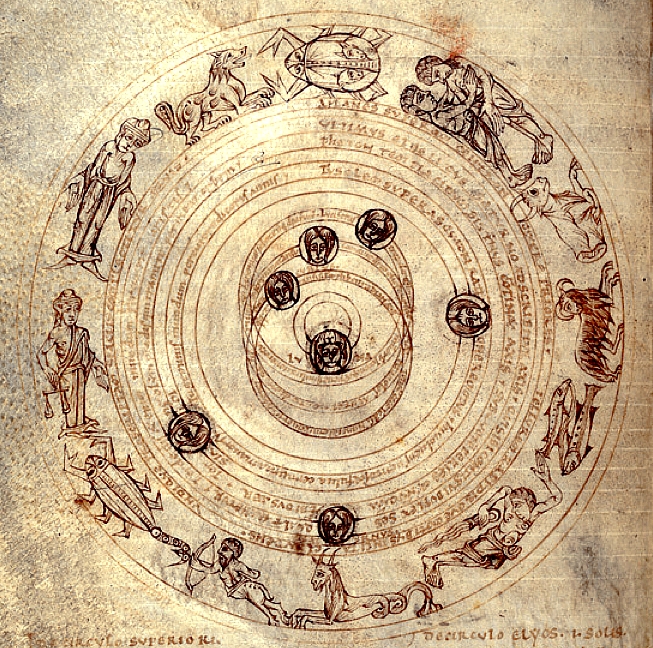
Three classic versions of The Empress tarot card, the third trump of the Major Arcana.
From left to right: 1. The Empress from the Visconti Bergamo deck, 1452.
2. L'impératrice from the Tarot de Marseilles, 1890 reproduction of Arnoult's 1748 edition. 3. The Empress from the Rider-Waite deck, 1910.

"Then again, via the Wiki entry for salamander folklore we learn that the Bretons of France so feared the salamander that to even utter the amphibian's name aloud was potentially lethal; especially if a local salamander was in ear-shot!  Oddly enough, however, the French King, Francis I (1494-1547), had as his symbol the salamander, and emblems carved with salamanders (inset, right) can be found in a number of places in his chateau at Fontainbleu... That a king might choose a salamander for an emblem is a curious thing, especially when his countrymen so loathed the creatures. Well, that is, unless King Francis had some knowledge of alchemy. For, it was around the time of Francis's reign that a Swiss-German alchemist by the name of Paracelsus ordained the salamander as the honorary elemental of fire, although it wouldn't be till the next century that Michael Maier regarded it as the metaphorical embodiment of the Philosopher's Stone."

- Quoting myself from the Trans-D Digital Art post, Eye of Newt.

"This is a zodiac illustration from a medical almanac, 1486. Ideas of astrology in medieval Europe were a long way from today's star sign horoscopes. Although some medieval astrologers were thought to be magicians, many were highly respected scholars. Astrologers believed that the movements of the stars influenced numerous things on Earth, from the weather and the growth of crops to the personalities of new born babies and the inner workings of the human body. Ancient studies of astrology were translated from Arabic to Latin in the 12th and 13th centuries and soon became a part of everyday medical practice in Europe. Doctors combined Galenic medicine (inherited from the Greek physiologist Galen - AD 129-216) with careful studies of the stars. By the end of the 1500s, physicians across Europe were required by law to calculate the position of the moon before carrying out complicated medical procedures, such as surgery or bleeding."

- Text and illumination (inset right) from this British Library page. The illumination is an example of the "zodiac man," illustrating the body parts the various zodiac signs ruled. Note the eight-legged, amphibious-looking Scorpion near the genital area.

"The first horoscopes written for Jadwiga's and Jogaila's child predicted a son in mid-September 1398. However, a girl was delivered on 22 June 1399 at Wawel Castle. Reports of the time stated that the child was born prematurely. According to the horoscope, however, she was actually born a bit late. More than a bit surely - a due date of 18 June would rule out the suspicion of pregnancy as early as mid-September."

- From the Wiki entry for Queen Jadwiga of Poland. I've used this quote to demonstrate how seriously astrology was considered throughout Europe at the time... especially for the royal houses who could well afford to keep court astrologers. Inset left is an example of medieval astrological chart.

***

Seriously, cats and kitties, when I first began this investigation, I neither intended to - nor expected to - come to any major conclusions regarding the mysterious maker(s) of the Voynich MS. Which is not to say that I've actually solved anything in the interim, but, as it turns out, I did ferret out another enigmatic personality to add to the Voynich mix... which will (no doubt) go against the grain of previous speculations, but, well, maybe it's time to shake up things a bit.

Now, obviously I'm not an expert in the medieval manuscript field, and virtually a neophyte when it comes to the Voynich MS, but, I love discovering new possibilities, and, when I do, well, in the spirit of Mac Tonnies, my impulse is to just throw the idea "out there." So, allow me to present (yet) another Voynich proposition to play around with... and you can blame it on the salamander.

As it happened (and as I mentioned in my last Voynich post), I had cause to research salamanders in 2016, at which time I discovered that, not only was the salamander an alchemical symbol, it was also the symbol of a certain French king: Francis I (12 September 1494 - 31 March 1547). Above inset right is one of Francis's wooden emblems of a salamander emerging from flames. Inset left is Francis I (as St. John the Baptist) from a painting by Jean Clouet). (Also, see: Francis the Salamander KIng.)

Anyway, for one crazy minute I wondered if the Voynich salamander was a reference to Francis I, but, as one can see by his birthdate, apart from the fact that he wasn't born with his sun in Scorpio (he was a Libra, as was his wife Claude), he was also born too late in the century to fit our time frame. So, that was one idea that wouldn't fly.*


Yet, In the end, I still had the feeling that some (if not all) of the figures wandering around on the zodiac pages represented actual people contemporary with the time and, possibly, born under the zodiac sign in which their caricatures are found. While this interpretation isn't without its flaws, there's seemingly no other recognizable purpose for the pages... nothing remotely "medical" nor particularly astrological beyond the central zodiac symbol. Moreover, a few of the zodiac pages (above: a page for Aries) seem to depict members of nobility - or even a royal house - in lieu of the marching nymphs.

Inset left is an another (actual) medieval astrological chart found here. Below is another 15th century "zodiac man."


In any case, if the drawings are caricatures of actual personalities and the (estimated) early 15th century time-frame is correct, identifying them - although seemingly an impossible task - might reveal (at the very least) the country of the manuscript's origin... and offer some clues regarding the author's true identity.

Ultimately (and essentially), it might only be necessary to identify a single one of them. My choice? The little Empress figure in the zodiac "chart" for Libra...